Information and Activities
About Amphibians
These clever creatures are just as much at home in water and on land. Frogs, toads and newts are all amphibians.
They have a backbone, they're cold blooded with soft water permeable skin - that means air can go through their skin - and many amphibians breathe through their skin instead of their lungs. They spend their time out of water in damp places like grassland or in leaf litter or beneath fallen logs.
Now watch this video to learn more about amphibians.
Common Frog
Adult common frogs spend the winter under rocks, or at the bottom of ponds, or you might even have them under your compost heap at home. They don’t truly hibernate, but essentially they are inactive over winter. In early spring they will head to a pond or standing water to breed.
Adult common frog...
- The males grow to about 9 cm and the females can be up to 13 cm long
- Colour - grey, olive green, yellow, brown
- Notice their dark patches on their backs and their striped back legs
- They have a dark ‘mask’ behind the eye, and an oval horizontal pupil
- They can breathe through their skin as well as their lungs
- They are most active at night
- Listen for their soft repetitive croaking
Jock knows spring is definitely under way when, by March, he sees clumps of frog spawn just under the surface of ponds, ditches and sometimes even in puddles. He is always a little anxious if it’s frosty as the frogspawn can die if it's too cold. He is fascinated by frogspawn, and watches as the weeks go by and the tadpoles develop.
It takes them two weeks to hatch; they have gills so they can breathe underwater. They feed on algae, becoming speckled with gold/brown as they grow. They go on to munch on leaves, moss and even small insects. From around 16 weeks the tadpoles start to grow their back legs, then front legs . Lungs form so the young froglets can breathe above water. Having fully absorbed their tails, they leave the water as young froglets, usually in the early summer, but sometimes as late as September.
This whole process is known as metamorphosis.
A young frog’s idea of a slap up dinner comes in the form of flies, slugs and snails which they catch with their sticky tongues-yuck!
Jock is always careful with his huge feet at these times so he doesn’t squash any!
Froglets and adult frogs are on the menu for owls, birds of prey, otters badgers and weasels. By laying loads of eggs, frogs hope that some will make it to adulthood, because fish, beetles, newts, rats and even foxes and hedgehogs think frogspawn makes a tasty treat!
Jock says : If you find frogspawn, enjoy looking at it safely from a distance, don't be tempted to take it home - please don't disturb it ! And don't be tempted to move it to another pond, as it could spread disease.
To find out more about frogs Common Frog (Froglife).
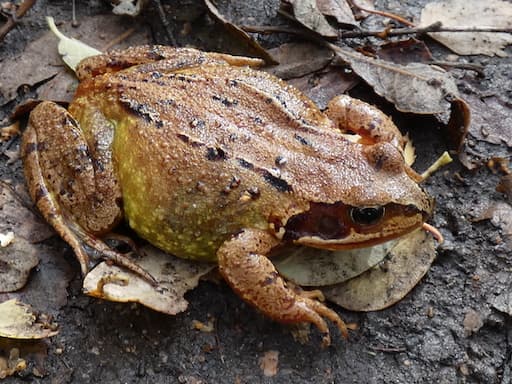 Frog (Credit Helen Rowe)
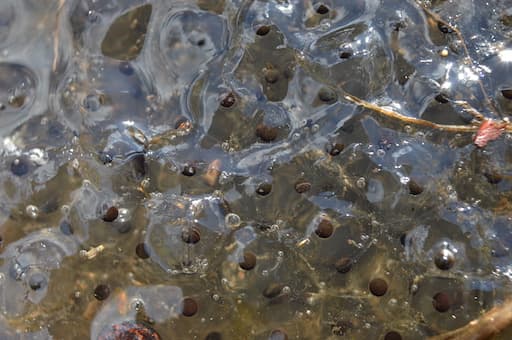 Frogspawn (Credit is Rob Rowe)
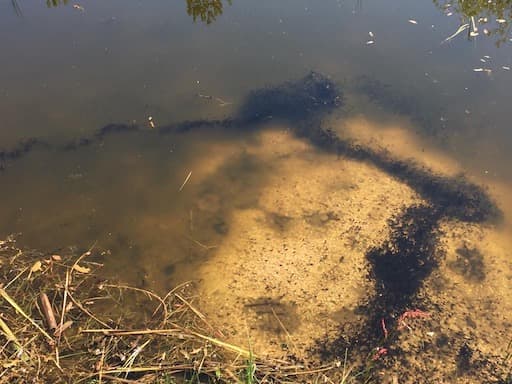 Tadpoles (Credit Sue Will)
Common Frogs (BBC SpringWatch)
Frogs and Toads of the UK
Five Ways to Help Frogs and Toads
Tadpoles (Credit Sue Will)
Common Frogs (BBC SpringWatch)
Frogs and Toads of the UK
Five Ways to Help Frogs and Toads
Common Toad
Britain’s largest amphibian, males are about 65mm, females 90 mm They live in damp log piles, leaf litter, fields, hedgerows, gardens and woodlands They eat worms, slugs, spiders, caterpillars, beetles, snails wood lice, ants, and incredibly, newts, young frogs and even mice!
Colour - varies according to the colour of the soil in their habitat - can be grey/brown, with an off white underside They spend most of their life on dry land
Like frogs, toads don't hibernate as such, but they are inactive over winter burying themselves in mud, under compost heaps or amongst dead wood.
In late spring they come out and on mild damp evenings and will head to their breeding ponds, using the same routes every year. Jock keeps an eye out every year, and sure enough they always appear, though their numbers have gone down.
The females lay strings of spawn, wrapped around vegetation. 2-4 weeks later the black tadpoles hatch out. After about 16 weeks, just like frogs, they start to grow their back legs, then their front legs. Once they have absorbed their tails, the tadpoles leave the water as toadlets.
In spite of producing a nasty tasting toxic milky substance when they feel threatened, toads make a tasty meal for hedgehogs, stoats weasels, rats, crows, magpies.
If you are interested in finding out more about toads please try some of these links.
What’s the difference between a frog and a toad?
To tell the difference between a frog and a toad you should look at,
- Skin - Toads are warty looking, covered with wee humps and bumps and nearly always have dry skin; frogs are smooth and always look wet.
- Legs - Toads have shorter legs and like to crawl, frogs have long legs, perfect for hopping.
- Shape - Frogs are slim and athletic looking; toads are squat and dumpy.
- Water - Frogs are rarely seen far from water; toads cope much better with dry conditions as their skin is more waterproof.
- Spawn - Frog spawn is laid in clumps; toad spawn floats in stringy lines.
For more about tadpoles: https://www.nhm.ac.uk/discover/frogspawn-tadpoles-and-froglets.html
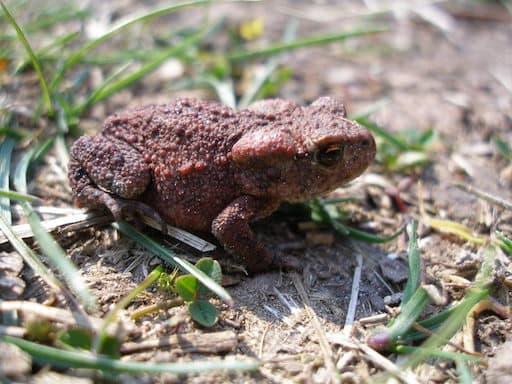 Toad (Credit Helen Rowe)
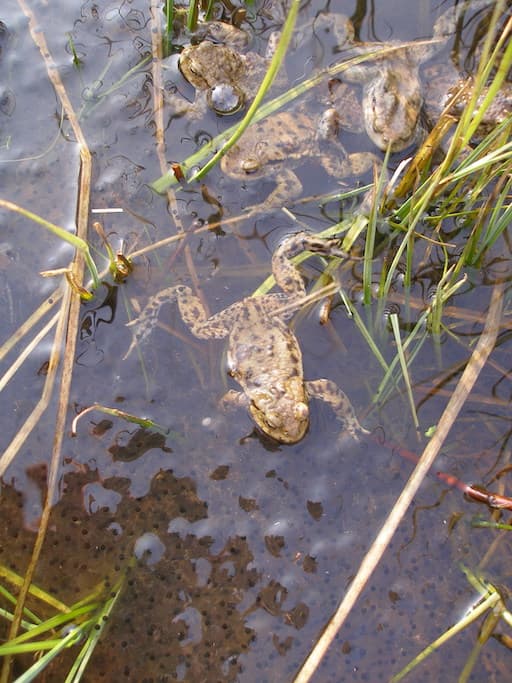 Toad and Frog Spawn (Credit Helen Rowe)
Palmate Newt
The little guys of the newt world, palmate newts are less than 9 cm long. Both the males and females have a pink/orange belly with a few spots, but none on the throat.
They like shallow ponds on acidic ground, and Jock says they're more common on Bennachie than the common newt!
They breed between March-July, with the male putting on a fine courtship dance to attract a female. He develops black webs on his hind feet and a filament on the end of his tail.
The female will lay a few greyish/white eggs every day for a couple of weeks, wrapping them round plants. You can tell a newt larvae from a frog or toad tadpole by its feathery gills around its head. Unlike frogs and toads, newt larvae develop their front feet first. It takes the larvae around 6-9 weeks once they hatch to grow into air breathing youngsters or ‘efts’. They can live up to 10 years!
Having bred in ponds during spring, these wee chaps spend the rest of their time munching on minibeasts in woodland , tussocky grassland and marshes. They do eat frogspawn and the odd tadpole too.
They’re inactive in winter under stones or in compost heaps.
To find out more about palmate, common and great crested newts browse this information.
How to help amphibians
Frogs and toads are in trouble and need our help!
The Natural History Museum has great ideas on how to help! See their Ways To Help Frogs And Toads information.
Or, why not make a newt, frog and toad abode?
See the instructions from RSPB Make A House For Fogs And Toads.
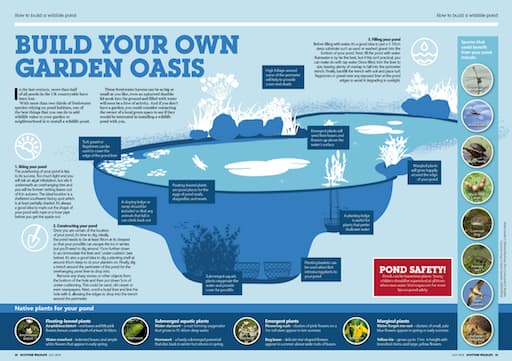 Build Your Own Garden Oasis (PDF)
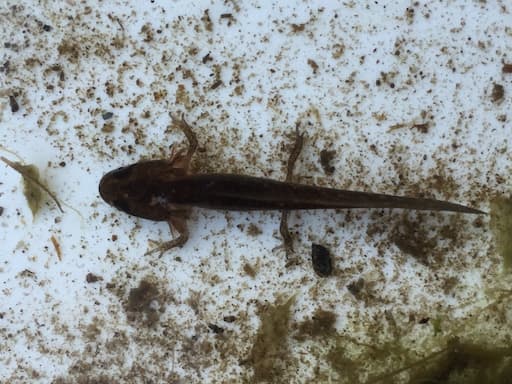 Palmate Newt Tadpole (Credit Helen Rowe)
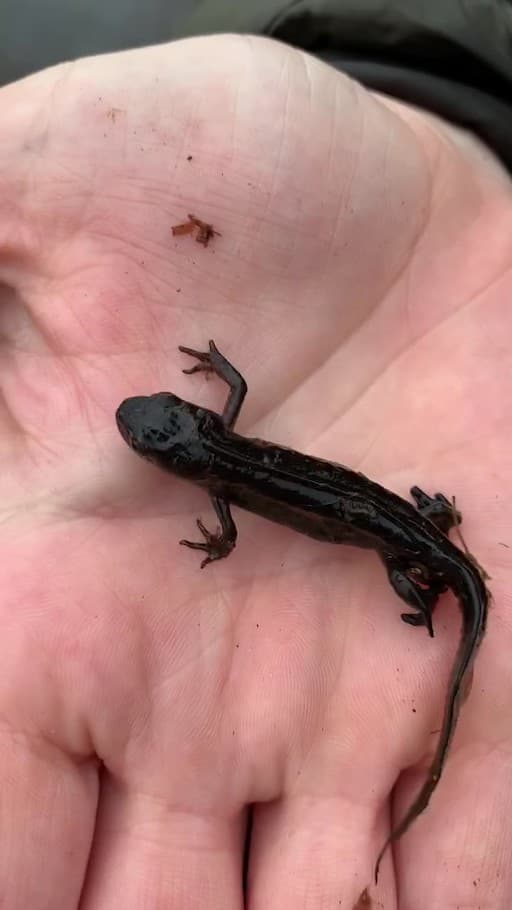 Palmate Newt (Credit Rob Rowe)
Staying Safe by Water
As days start to lengthen and temperatures slowly begin to rise, life begins to stir in ponds and lochs. Bubbles of frogspawn start to form, water boatmen skim across the water’s surface, toads do breaststroke, aquatic plants shift from greyscale into colour, caddisfly larvae build their remarkable cases, and birds fly low looking for insects… If you’ve got a curious mind, you might want to take a closer look… There’s a lot to be seen! But water is hazardous, not somewhere to let small children or dogs out of sight, even for a moment. If there is potential for a child or dog to get out of control, it is time to move away from the water’s edge, and return when spirits are calmer.
Things to remember:
- Weather has there been a lot of ice, snow or rain in recent days? It doesn’t matter if it’s dry today: if there’s snowmelt, or it’s been raining all weekend, there is a strong probability that rivers and ponds will have burst their banks. Water is likely to be deeper and faster-flowing, and much harder to safely investigate. Plan your visit for when the levels have dropped again!
- ground may be very muddy, uneven, or covered in reeds, and is not necessarily solid. It is impossible to accurately judge the depth of water just by looking. So make sure you’re standing on solid ground!
- Just as you can’t know how deep water is, you can’t know how thick ice is going to be, or if it will bear your weight. Clinging onto a dead tree branch isn’t going to give you any support! Don’t risk it. Instead, launching pebbles or pine cones out onto the ice is great fun!
- Your phone, or any other electrical items, will be unlikely to respond well to getting wet. Waterproof cases and dry bags are very useful.
- Cotton and denim clothing, once wet, will get bitterly cold, very heavy and take ages to dry; fleeces and waterproofs are much better.
- If in doubt, stay away. Rivers and ponds and all the life in them will still be there when the conditions are right for you!
Things you should pack in your rucksack if you’re going to be near a body of water:
- Flask with a hot drink – this is essential for warming yourself up.
- A snack (something high energy, like a chocolate bar).
- Spare layers – an extra fleece is really important.
- Hat, gloves and scarf, plus a change of socks.
- First aid kit.
- A camera, notebook and pencil, and tupperware box for samples – tadpoles, maybe? – might be fun too!
If, despite best efforts, you do get wet, you should move fast to (a) remove wet clothing, (b) replace with warm dry clothing (the spare layers in your rucksack, including hat, gloves and scarf), (c) have a quick drink of something warm from your flask, and maybe a bite of sugary food, and (d) get yourself home! If this involves a drive, turn up the heating in the car. And once you’re home and warmed up a bit, have a shower or a bath, and afterwards you can bask in the fact that you are safe and clean and cosy!
Also See
Also see our Summer Programme, Spring Programme, Winter Programme and Autumn Programme
If you have enjoyed these activities please share them with your friends and family.