Although wintery forests and woodland can seem quiet, in fact lots of animal activity will be going on all around you.
Wild creatures can be hard to spot, most are very shy, and many only come out at night. However, if you look closely you might see feed signs, tracks or droppings left behind.
So why not try this winter to become a nature detective, and spot the clues the animals have left behind!
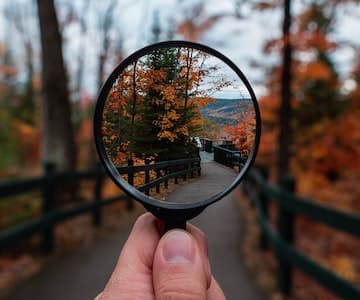
Information and Activities
Tracking
Winter is great for animal tracking-with lots of juicy soft mud and sometimes snow just waiting for a furry or feathered foot to step in it!
So eyes down and see who’s put their foot in it!
Here are some guides to get you started:
 Mammal Tracking
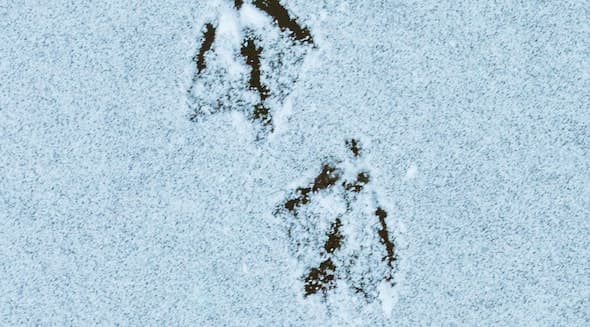 Animal Tracking : prints and poo identification for kids (Woodland Trust)
Can you identify badger tracks?
Tracks in the snow
 CHECK
Identify Animals Prints In The Snow (Wildlife Watch)
CHECK
Identify Animals Prints In The Snow (Wildlife Watch)
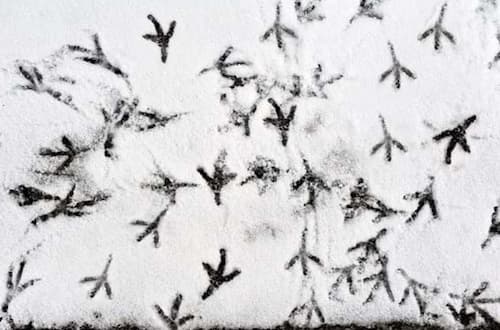 Identify Animals Prints In The Snow (Woodland Trust)
Why not make your own animal tracker and detect who’s been passing through your garden!
See RSPB's Make An Animal Tracker.
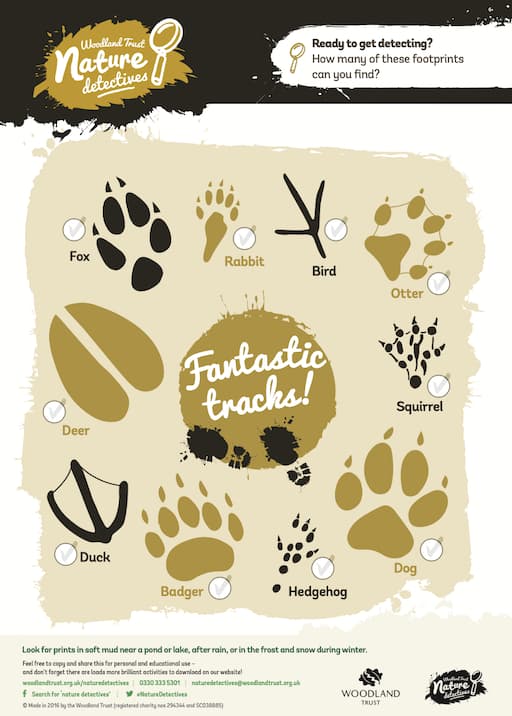 Ready to get detecting? How many of these footprints can you find? (Woodland Trust)
Tracking the Animals of Bennachie
Why look for track and sign?
- Most mammals are secretive and hard to see.
- Tracks and signs (droppings, hair, feeding signs, holes, claw marks etc) indicate to us that a certain animal has used that site. We don’t need to see it. No sign doesn’t, however, mean no animals!
- Tracks and signs allow you to build up a picture of the what the animal has been doing – sleeping, feeding, running, scent marking.
- It’s the meeting place between science and storytelling – it involves using your imagination as well as collecting evidence and researching animals and their habitats.
What you need
- A ruler, either a 150mm ruler, or better still a folding 1m ruler.
- A notebook and pencil
- A camera or phone
- Hand lens (useful)
- Hand sanitizer
- Some old polythene bags or small plastic pots for collecting signs (chewed nuts, feathers etc).
- Some good track and sign ID books. Here is a short list of ones I’ve found helpful:
Mammal Tracks and Signs. A Guide to North American Species by Elbroch.M. Pub. Stackpole Books.
Despite being based on American mammals, this is the best book I have as a guide to track, gait and sign. Most mammals here have close cousins in the US or are indeed the same species. Highly recommended as both an introduction to the art of tracking as well as an ID guide to species.
Collins Field Guide, Mammals of Britain and Europe by MacDonald, D., Barrett, Pub. Collins. Good up-to-date field guide with some illustrated track and sign.
Tracks and Signs of Birds of Britain and Europe, an Identification Guide by Brown, R., Ferguson, J., Lees, D. Pub. Chrisopher Helm.
RSPB The Nature Tracker’s Handbook by Nick Baker; Pub. Bloomsbury Wildlife
What to do
On finding a track or sign:
-
First look very closely at the details you see. It’s best if the sun is on the opposite side of your track when you look at it. Be a nature detective and ask yourself useful questions such as ‘What sort of animal could leave a track of this size?’ Use your imagination.
- Look at the number of toes, the size and shape of the palm pad, the space between the toe pads and palm pad. Look for dents made by claws.
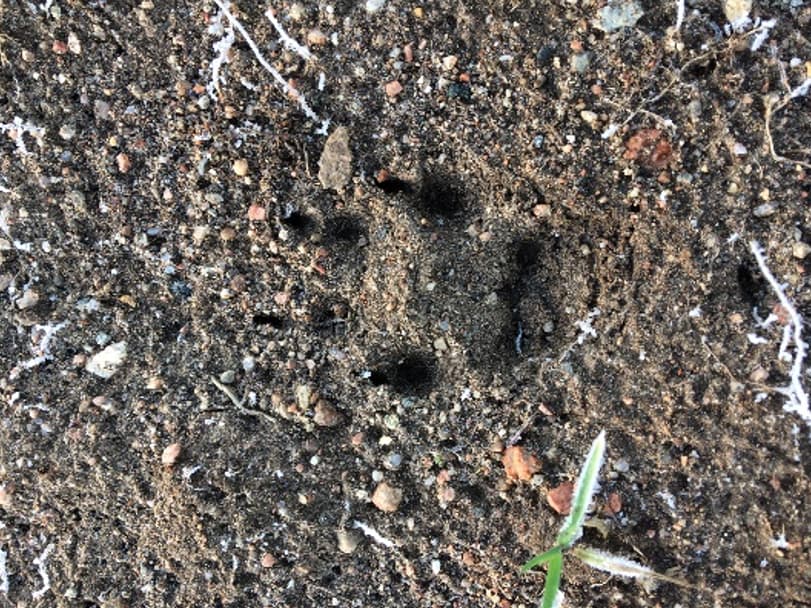 A Fox Track
Is there is more than one track? If so, what pattern do the tracks make? Was the animal bounding (like a rabbit), walking, trotting or galloping? How an animal moves is an important clue to identification.
If it’s a dropping, don’t pick it up but look closely to see if there are any bones or feathers. What shape is it? What size? Where is it placed? Take a photo so you can examine it magnified.
- Next stand back and look for a trail or the context (a river, a tussock of grass, woodland edge, muddy pool etc) in which you’ve found the tracks or sign. Are there more tracks or trails leading away from the hole? Other signs?
- Think about the whole environment around the hole, the snagged hair or tracks. Think about what you know about the area – cover, water, food resources, roads.
- Choose three animals that may have left the track or sign and gradually eliminate them until you are left with the most likely culprit.
- Lay your ruler next to the track or sign and take a photograph from various angles so you can look it up or send it to an expert for identification when you get home.
- It’s a really good idea to keep a notebook. You can print and paste in your photos, make sketches and record details of what you have found out about the track or signs. It’s one of the best ways to build up your skills!
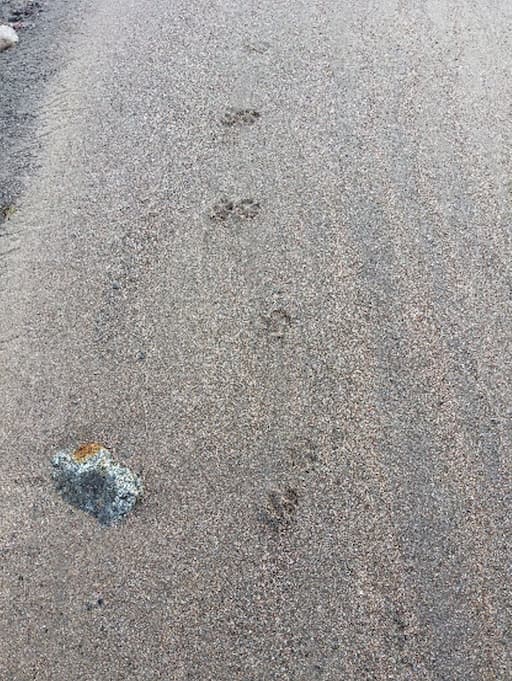 A Fox Trotting
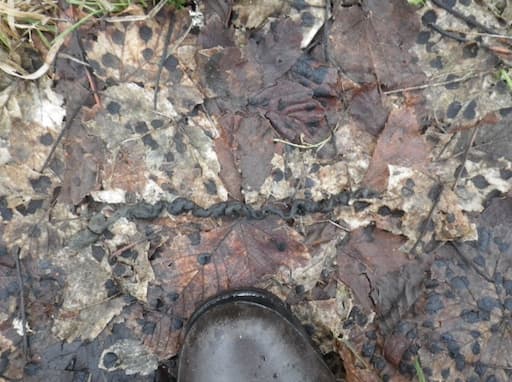 A Pine Marten Dropping or Scat
Test Your Tracking Skills #1
Show Image #1 | Show Image #2
Who Made These Tracks?
They are 3.5 cm wide.
View both Image #1 and Image #2 before deciding.
Yes, A Fox - Well done!
Foxes have four toes that show up in a track. The whole track is diamond shaped. They have very furry feet so there is a lot of space between the toe pads and the palm pad. Two claws (known as ‘buddy claws’) are often visible at the front of the track. The usual gait for a fox is a trot when the hind foot lands neatly on top of the front foot track – called a ‘direct register’.
The other tracks in the snowy photo are made by a mouse.
The track below is made by a dog. Again, four toes but the track is squarer and not so narrow. You can see how much bigger the palm pad is and how close it is to the toe pads. Dogs also trot but lope more often than foxes.
Have a closer look and try again.
Try Again
Test Your Tracking Skills #2
Show Image #1 | Show Image #2
Who Made These Tracks?
They are 3 cm wide: Dog, Cat, Badger or Otter?
View both Image #1 and Image #2 before deciding.
Yes, A Cat - Well done!
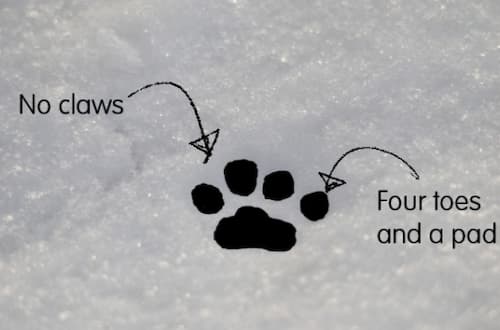
Cats have four toes that show up in a track. All the pads are large. There is a small fifth toe higher up on the leg that does not register.
There is little space between the toe pads and the very large, three-lobed palm pad which looks a bit like a cartoon nose.
The hind foot is more elongated than the fore foot. The fore foot is wider.
The claws are not often visible as they are usually retracted. The normal gait for a cat is a walk.
This track was also made by a cat. When they walk cats place the back foot directly in the track of the forefoot (a direct register) making it look as though the track has 5 or even 6 toes!
Have a closer look and try again.
Try Again
Test Your Tracking Skills #3
Show Image #1 | Show Image #2
Who Made These Tracks?
They are about 2.5cm wide. A Rabbit, Pine Marten, Squirrel or Rat?
View both Image #1 and Image #2 before deciding.
Yes, A Red Squirrel - Well done!
Like all rodents squirrels have four toes on the fore foot and five on the hind foot.
In the photo the hind feet are in front as squirrels bound like a rabbit, the powerful hind feet land in front of the fore feet and propel the animal forwards.
The hind foot is long with the heel often showing in the track and the three middle toes point forward, which is typical of the rodent family.
The claws do not always register.
The fore feet are smaller and there is an arrangement of three small palm pads in a triangle, followed by a pair of palm pads below.
The middle toes of the fore feet point forward and the lower two to the sides.
These tracks were made by a rabbit. The hind feet point forwards and are parallel rather than angled outwards as they are in a squirrel track, and the toes come to a point.
Have a closer look and try again.
Try Again
Test Your Tracking Skills #4
Show Image #1 | Show Image #2
Who Made These Tracks?
They are about 6 cm wide. Who made these tracks Badger, Pine Marten, Fox or Otter?
View both Image #1 and Image #2 before deciding.
Yes, An Otter - Well done!
Otters belong to the mustelid family that includes badgers, pine martens and stoats. All mustelids have five toes on both their hind and fore feet. The thumb does not always register.
The track on the right is a left hind foot. The thumb or toe 1 is placed much lower than the other four toes. The toe pads and palm pads are quite large and fused in the hind foot. In the photo you can see the webbing between the toes, but this does not always show.
The heel pad is often visible on the fore foot, which is more rounded with a smaller, V-shaped palm pad. Can you spot the other fore foot?
Otters usually move in a looping lope because of their short legs and long spines.
These tracks were made by a bitch and cub. The cub is having to leap to keep up with its mother who is moving at a steady lope.
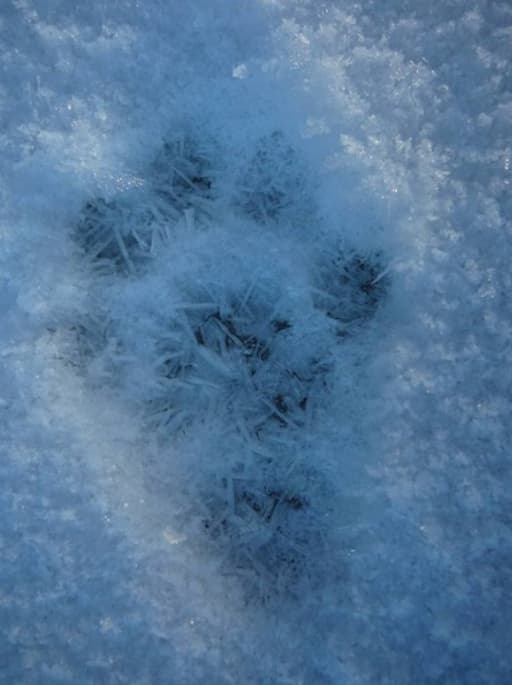
Which foot is this, hind or fore?
Have a closer look and try again.
Try Again
Test Your Tracking Skills #5
Show Image #1 | Show Image #2
Who Made These Tracks?
They are 4-6 cm wide. Who made these tracks Badger, Pine Marten, Dog or Mink?
View both Image #1 and Image #2 before deciding.
Yes, A Badger - Well done!
Badgers belong to the mustelid family which includes otters, weasels, mink and stoats. All mustelids have five toes on both their hind and fore feet.
This is a badger’s left fore foot. The thumb, or toe 1, on the right of the track is placed lower than the other four toes. Compare it with your own left hand.
Toes 2-5 are almost in a straight line.
The toe pads are large and the palm pad enormous. There is very little space between the toes and palm.
In the photo you can see the long claw marks. Claws are a badger’s digging tool.
The claws on the smaller hind feet are shorter.
The badger’s normal gait is a walk when they place the hind foot just behind and overlapping the front track.
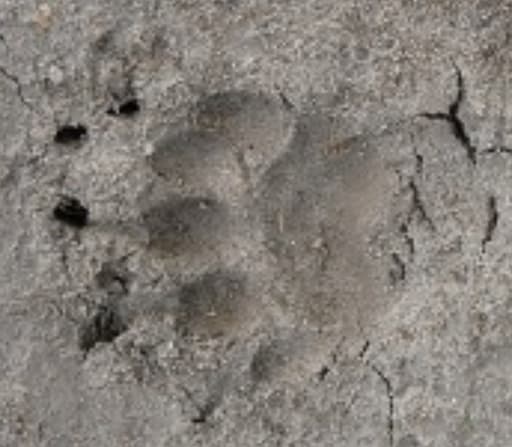 Is this a left or a right hind foot?
Have a closer look and try again.
Try Again
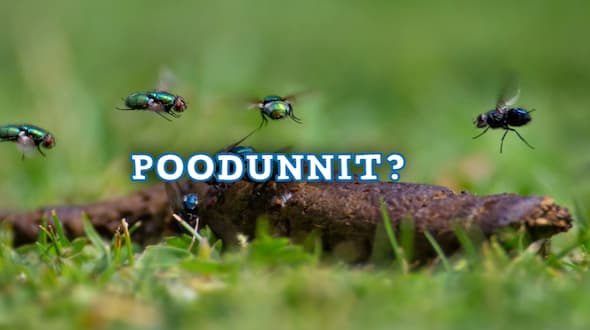
Poodunnit!
Animal droppings, or scat give brilliant clues about who has ‘been’ there! To work out poodunnit, notice the size, shape and colour of the scat , and break it apart with a stick to see what the animal has been eating. Clues could be fur, tiny bones, berries and seeds.
Fun Activity: Try the RSPB's Whose Poo? game to see how good you are at recognising poo! It is great fun!
Here are some guides to common mammal droppings, and what to look (or smell).
 CHECK
CHECK
Okay let’s play the RSPB's RSPB Whose Poo? with this quiz-sorry about the sound effects!
Jock Says: Never touch animal poo as it contains bacteria which could make you ill - always wash your hands after you have been out nature detecting
 RSPB Whose Poo?
Jock's Winter Jokes
Is it quicker to be hot or cold?
Hot, because you can catch cold!
Also See
Also see our Summer Programme, Spring Programme, Winter Programme and Autumn Programme
If you have enjoyed these activities please share them with your friends and family.